
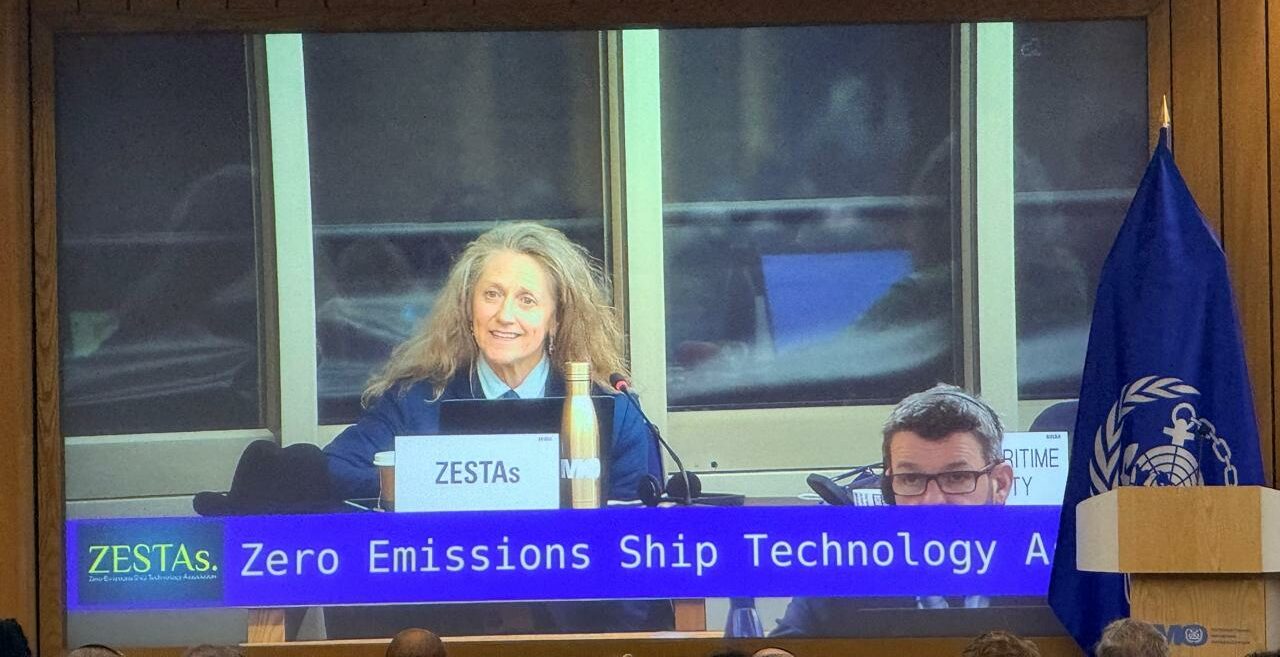
Thank you, Chair.
ZESTAs aligns with the interventions by IMarEST, EDF, Clean Shipping Coalition, Pacific Environment and those countries named by Pacific Environment, and financial elements stated by IMarEST.
While we are one of the few industry delegations actively voicing our commitment to the 2023 Strategy this week, we are not alone. Monday’s joint shipowners’ letter mentioned by IMarEST proves the vast majority of shipping shares this view.
They urge the IMO to uphold the 2023 ambition to protect billions in industry investments. We must move toward net-zero deliberately, without wasting time on half-measures at half-speed. The Net Zero Framework provides the exact certainty investors require.
ZESTAs and its members have joined nearly 100 companies, including shipowners, ports, fuel producers, and technology providers in signing a statement calling on Member States of the IMO to adopt the IMO’s Net-Zero Framework this year. Further delay risks, undermining international investments needed to scale alternative fuels, vessels and infrastructure.
ZESTAs’ members supply the pivotal technology to meet these goals. We know the industry’s economic vitality relies entirely on regulatory certainty and a clear, defensible pathway to net-zero by 2050 that can only come from the IMO.
Yes, this transition requires trillions in investment over the next 25 years. But after a decade of constructive debate, we know how to mitigate those costs, ensure a level playing field, and deliver a fair transition for all states.
Those citing high regulation costs frequently ignore the massive benefits, especially for the most vulnerable states, and the catastrophic costs of inaction. Contextualised, this transition actually costs very little.
Compared to the nearly $7 trillion USD of goods moved annually, according to UNCTAD, an investment of $40 – 60 billion USD per year, according to GMF, is a fraction of a percent: roughly $5 USD per tonne of cargo or $50 USD per container. This modest investment ensures our industry thrives, fulfils the IMO’s international duty, and creates a stable energy system decoupled from the volatile politics and economics of conventional fuels.
Chair, we agree with the majority in this room: elaborate carbon pricing schemes are not an end in themselves; they must actually reduce emissions to “near-zero” by 2050. Our members stand ready to provide the technologies to make this a reality, ensuring equal access for all Member States.
Thank you, Chair