
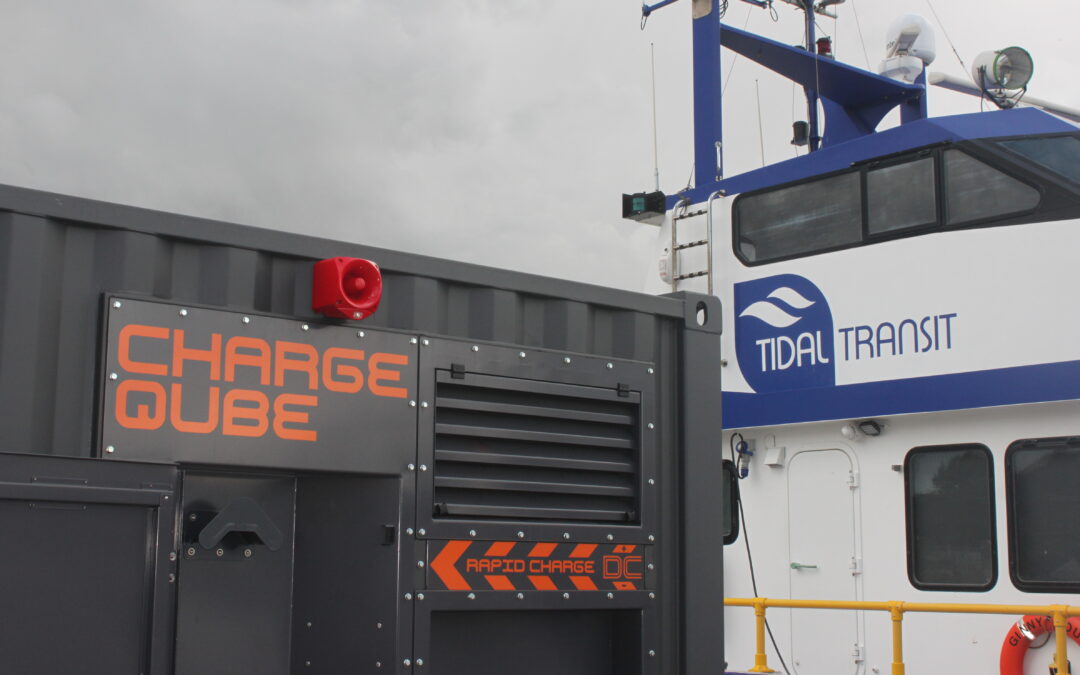
Marine electrification specialist Tidal Transit has deployed Fellten’s Charge Qube battery energy storage system (BESS) to support onshore charging for e-Ginny, its retrofit electric crew transfer vessel (E-CTV).
The deployment supports Tidal Transit’s transition away from diesel for offshore wind operations and maintenance fleets, while addressing one of the key challenges facing marine electrification: limited grid capacity at portside locations.
Fellten’s Charge Qube provides mobile battery energy storage that can be transported directly to where charging power is required. Its range extends from the CQ160, offering 160 kWh of storage, to a planned flagship 1 MWh system.
Tidal Transit selected the CQ450, which provides 450 kWh of electricity storage in a mobile, modular battery system. The system can be relocated between shoreside locations and offers charging at up to 240 kW for e-Ginny while docked.
The use of portable, containerised battery storage enables high-power vessel charging at locations where existing onshore grid infrastructure cannot yet meet demand, helping bridge the gap between the deployment of electric vessels and the development of supporting port infrastructure.
Leo Hambro, co-founder and CEO at Tidal Transit, commented:
“One of the biggest challenges facing marine decarbonisation is that electric vessel technology is advancing faster than the supporting infrastructure onshore. If we’re serious about reduced fossil fuel dependence and decarbonising offshore wind logistics and wider maritime operations, we need practical charging solutions that work now, not years down the line.
“Fellten’s Charge Qube gives us exactly that. It provides the flexible, high-power system to support overnight charging capability we need for e-Ginny and other electric and hybrid vessels without being limited by local grid constraints. It’s a strong example of how smart, mobile infrastructure can help accelerate the transition to electric and move the wider marine industry closer to a zero-emission future.”
Mike Ellenthorpe, general manager at Fellten, added:
“Tidal Transit’s e-Ginny is the perfect demonstration of what Charge Qube can enable: a real working vessel, operating in a demanding commercial environment and supported by flexible charging. We’re incredibly proud to support such a landmark project and believe e-Ginny will provide a powerful blueprint for the wider electrification of marine fleets.”
Tidal Transit’s e-Ginny project has transformed the diesel-powered vessel Ginny Louise into a fully electric CTV, alongside the development of offshore charging infrastructure.
Combined with Fellten’s new onshore charging solution, the project is supporting Tidal Transit’s work to electrify offshore crew transport and reduce the operational carbon footprint of the offshore wind sector.